


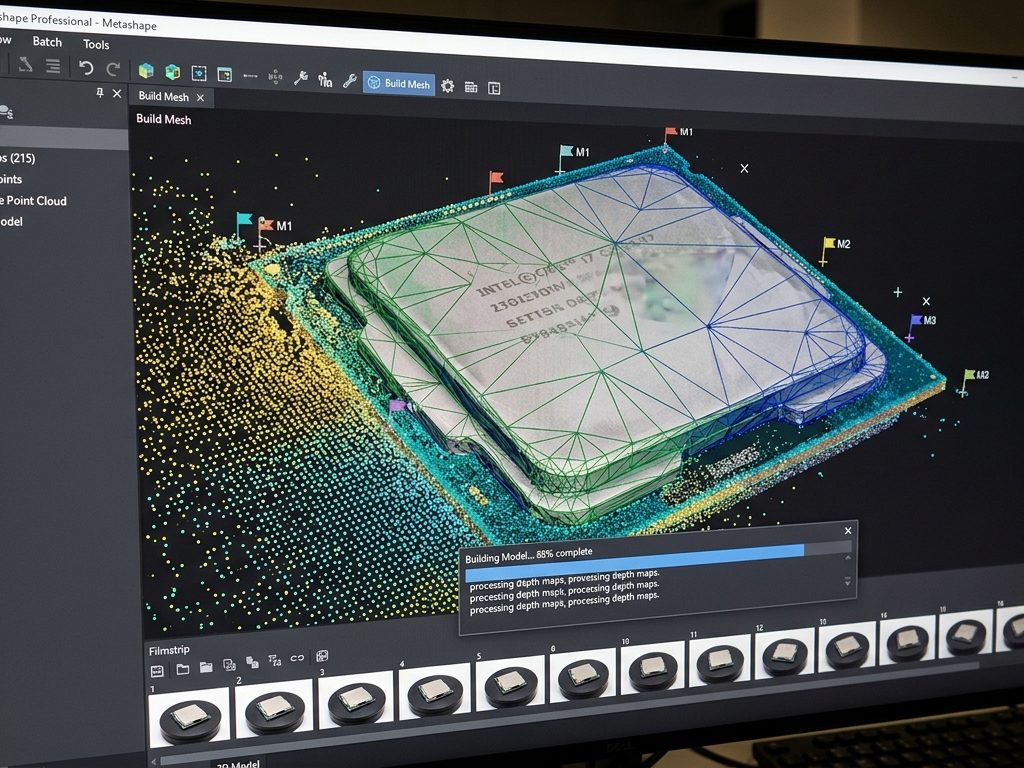
One of the most frequent questions from those starting out with Agisoft Metashape is: “Should I invest in a more powerful GPU or a faster CPU?” The answer isn’t simple, because Metashape uses both components, but at different stages and with very different impacts. In this article, we explain it in detail so you can make the best decision when configuring or upgrading your system.
The fundamental rule: each component takes over at different stages.
Metashape divides photogrammetric processing into several stages. The key is understanding that the GPU dominates the longer stages , while the CPU is crucial in intermediate and management stages. It’s not a simple “vs”: the two work together, but with distinct roles.
What stages does the GPU use?
Metashape supports GPU acceleration for the following stages, which are also the most demanding and slowest in the workflow:
| Stage | Main component | Impact on total time |
|---|---|---|
| Image Matching (Part One of Aligning Photos) | GPU | High |
| Calculation of depth maps (dense cloud base) | GPU | Very high |
| Mesh generation from depth maps | GPU | High |
| DEM generation and tiled model | GPU | High |
| Mixing textures (second part of Building Texture) | GPU | Half |
What stages does the CPU use?
| Stage | Main component | Impact on total time |
|---|---|---|
| SIFT Point Detection (first part of Align Photos) | CPU | Half |
| Bundle Adjustment (camera optimization) | CPU | Half |
| Point cloud classification | CPU | Low to medium |
| Export of products | CPU | Low |
| Memory and file management | CPU | Low |
The direct conclusion is that the GPU is the most crucial component for reducing processing times in Metashape because it handles the longest stages. That said, a slow CPU can become the bottleneck in stages that lack GPU acceleration.
How much does the GPU impact real-time performance?
The difference between processing with and without a dedicated GPU is very significant. Metashape supports CPU-only processing, but stages that support GPU acceleration will take considerably longer, so using systems without a dedicated GPU for processing operations is not recommended.
To give a concrete idea, as a guideline for a project of 300 photos at 20 MP in High quality:
| Configuration | Estimated time (dense cloud) |
|---|---|
| CPU only (no dedicated GPU) | 6–12 hours |
| Mid-range GPU (RTX 3060, 12 GB) | 1.5–3 hours |
| High-end GPU (RTX 4080, 16 GB) | 45–90 minutes |
| Flagship GPU (RTX 4090, 24 GB) | 30–60 minutes |
These are approximate times. They vary depending on the complete hardware, image resolution, and quality parameters chosen.
Generating the dense point cloud can account for more than half of the total processing time in a typical project, making the GPU the most influential factor in daily productivity.
📷 Image idea (AI): Horizontal bar chart comparing processing times according to GPU (No GPU / RTX 3060 / RTX 4080 / RTX 4090), with gradient color bars from red to green, technical infographic style on dark background.
Which GPU performs best in Metashape?
NVIDIA vs AMD
Metashape supports both NVIDIA GPUs (via CUDA) and AMD GPUs (via OpenCL). In practice, NVIDIA GPUs have a consistent advantage due to the maturity of the CUDA ecosystem and the greater number of available optimizations. Modern AMD GPUs also perform well, but if maximum performance is the priority, NVIDIA is the safer choice.
The two key factors when choosing a GPU for Metashape
1. Number of CUDA cores (NVIDIA) or shader processors (AMD): GPU performance in Metashape is primarily linked to the number of compute units. More CUDA cores = faster depth map calculations.
2. Available VRAM: The amount of VRAM determines the size of projects that can be fully processed on the GPU. With insufficient VRAM, Metashape has to divide the work or resort to system RAM, which slows down processing. For mesh generation, DEMs, and high-resolution tiled models, more VRAM is directly better.
Recommended GPUs by segment (2025–2026)
| Segment | GPU | VRAM | For what projects |
|---|---|---|---|
| Entrance | RTX 4060 Ti | 8–16 GB | Small projects (up to 200 photos) |
| Mid-range | RTX 4070 / RTX 4070 Ti | 12–16 GB | Medium-sized projects (200–600 photos) |
| High-end | RTX 4080 | 16 GB | Large projects (600–1,500 photos) |
| Flagship | RTX 4090 | 24 GB | Very large projects, intensive daily use |
| AMD Alternative | RX 7900 XTX | 24 GB | Good performance at a lower price |
Is a professional GPU (NVIDIA RTX 6000, Quadro) worth it? Generally, no, for Metashape. These cards are optimized for double-precision computing, which Metashape doesn’t utilize. A gaming-grade RTX 4090 outperforms professional options that cost three times as much.
📷 Image idea (AI): Two NVIDIA GPUs side by side, photorealistic render with dramatic blue-green lighting, dark background with circuit effect.
Which CPU performs best in Metashape?
The counterintuitive rule: more cores are not always better
Unlike rendering applications that scale almost linearly with cores, Metashape has a more nuanced behavior. Some stages benefit from many cores (sorting, exporting), while others depend critically on the speed of a single core (Bundle Adjustment, intermediate stages).
Puget Systems’ benchmarks confirm that high-core-count processors, such as the 96-core Threadripper PRO, do not scale efficiently in Metashape. The sweet spot is between 8 and 24 cores with a high base clock speed.
Recommended processors
| Segment | CPU | Nuclei | Base frequency |
|---|---|---|---|
| Mid-range | AMD Ryzen 9 9900X | 12 | 3.6 GHz |
| High-end | AMD Ryzen 9 9950X | 16 | 3.5 GHz |
| High-end Intel | Intel Core Ultra 9 285K | 24 | 3.7 GHz |
| Workstation | AMD Threadripper PRO 7965WX | 24 | 3.8 GHz |
The Intel Core Ultra 9 285K and the AMD Ryzen 9 9950X lead the Metashape benchmarks for desktop configurations in 2025–2026, according to data from Puget Systems.
📷 Image idea (AI): AMD Ryzen or Intel Core CPU on a high-end motherboard, photorealistic render with warm lighting, dark background with visible PCB.
The setting that nobody configures (and that impacts performance)
There is a setting in Metashape that Puget Systems identified as a frequent source of poor performance and even instability, and which most users never check:
Tools → Preferences → GPU
On that panel:
- Make sure all your GPUs are selected (if you have more than one).
- Uncheck the ” Use CPU during GPU processing ” option .
Contrary to what might seem intuitive, using the CPU simultaneously during GPU stages generally lowers overall performance and can cause errors. The GPU performs best when it has exclusive access to the work it’s optimized for.
If you have an integrated GPU (Intel Iris, AMD Radeon integrated), be sure to also uncheck it in that panel. Metashape may try to use the integrated GPU for certain tasks, which can cause significant bottlenecks.
📷 Image idea (AI): Stylized screenshot of Metashape’s GPU Preferences panel with visible options, on a dark interface background.
Multi-GPU: Is it worth it?
Metashape supports the use of multiple GPUs simultaneously. In theory, two GPUs should halve processing time. In practice, the improvement exists, but with diminishing returns.
Recommendations for multi-GPU configurations
- Use GPUs from the same manufacturer (NVIDIA + NVIDIA, or AMD + AMD, do not mix).
- The difference in TFLOPs between the two GPUs should not exceed double .
- The difference in Memory Bandwidth should not exceed 1.5× .
- Investing in a single high-end GPU generally offers better cost-performance ratio than two mid-range GPUs.
What should I upgrade first if I have a limited budget?
If you have to choose between upgrading the GPU or the CPU, the answer for Metashape is almost always the GPU first , because it controls the longest stages of processing.
| Situation | What to update |
|---|---|
| You primarily process point clouds and meshes | GPU (high priority) |
| Your CPU has 4 or fewer cores | CPU (general bottleneck) |
| You run out of memory on large projects. | RAM (before GPU or CPU) |
| You process projects with more than 1,000 photos | GPU with more VRAM |
| You work in surveying with many GCPs | CPU (Bundle Adjustment) |
Summary: GPU or CPU depending on the case
¿Qué querés mejorar?
│
├── Tiempo de procesamiento general → GPU (impacto mayor)
├── Velocidad de alineación de fotos → GPU + CPU equilibrado
├── Proyectos grandes sin quedarse sin memoria → RAM + GPU VRAM
├── Bundle Adjustment / optimización de cámaras → CPU (frecuencia alta)
└── Clasificación y exportación → CPU (múltiples núcleos)
Conclusion
The GPU is the most critical component for Metashape’s day-to-day performance, as it handles the longest stages: image matching and generating depth maps for the dense cloud. A powerful CPU complements this work in the intermediate and optimization stages, but it’s rarely the primary bottleneck in a system with a high-end dedicated GPU.
The most impactful and free adjustment you can make today is to check Tools → Preferences → GPU and make sure the settings are optimized as explained above.
At Aufiero Informática , official distributors of Agisoft Metashape in Argentina, we can help you choose the right license and guide you on the most suitable hardware configuration for your workflow.
👉 View Agisoft Metashape licenses at Aufiero Informática
Frequently Asked Questions
Can I use Metashape without a dedicated GPU? Yes, Metashape can run on CPU only. However, stages that support GPU acceleration will take considerably longer. It’s viable for small test projects; for regular professional use, it’s not recommended.
Does NVIDIA or AMD perform better with Metashape? Both brands work. NVIDIA has an advantage due to the maturity of its CUDA architecture and a greater number of historical optimizations. Modern AMD with OpenCL also offers good performance. If the goal is maximum performance without compromise, NVIDIA is the safer choice.
Are Apple Silicon chips (M1-M4) good for Metashape? Yes. Starting with recent versions, Metashape offers native support with GPU acceleration for Apple Silicon. The M3 Pro/Max and M4 Pro/Max chips are very competitive for medium-sized projects. For large projects with thousands of photos, a Windows workstation with an RTX 4080/4090 is still faster.
Does it make sense to use two identical GPUs in Metashape? It makes sense if you regularly process large projects and the GPU is the only bottleneck. In most cases, a single high-end GPU offers better price-performance than two mid-range ones.
Does the GPU help visualize the model while I work? Yes, the GPU also handles real-time 3D visualization within Metashape (rendering the point cloud, mesh, and textures). With limited VRAM or integrated GPU, visualizing large models can be slow or unstable.